


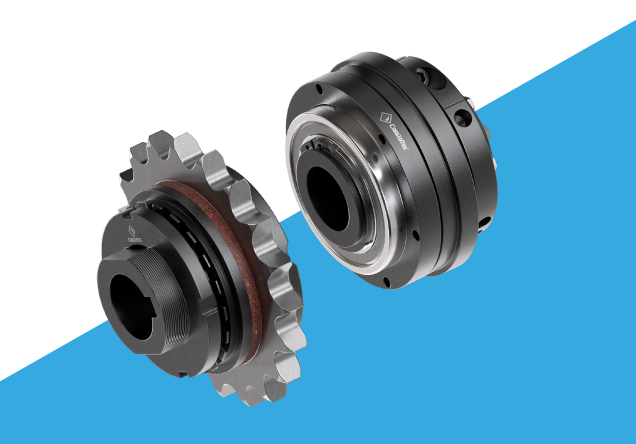
TORQUE LIMITER: WHAT IS IT AND WHAT IS IT USED FOR?
A torque limiter (or safety clutch) is a mechanical device designed to protect transmission systems from overloads.
Its operation is simple but fundamental: when the transmitted torque exceeds a set limit value, the device automatically intervenes, preventing damage to the system or its components.
In a mechanical transmission, exceeding the rated torque can lead to:
- Component failure;
- Machine downtime;
- Costly plant stoppages;
- Loss of productivity.
The torque limiter prevents all of this by activating at the precise moment when a fault occurs.
WHAT ARE THE BENEFITS OF HAVING A TORQUE LIMITER?
Within a mechanical transmission, the behavior of the system changes significantly depending on whether or not a torque limiter is present.
Under normal conditions, the transmission operates within a predetermined and calculated torque value; the system functions smoothly. When an anomaly occurs, such as an obstacle, a jam or an overload, the system is faced with a situation that needs to be managed:
- Without a torque limiter, the increased torque is discharged directly onto the transmission components, eventually causing the weakest element to fail;
- With a torque limiter, the device automatically intervenes when the torque exceeds the set value, thereby protecting the system.
Depending on the technology used, this intervention can take place in various ways:
- Slippage (friction-type limiters): The device limits the transmitted torque by allowing relative slippage between the driving and driven components while keeping the transmission active in a controlled manner;
- Disengagement (ball or roller limiters): The system completely separates the drive, stopping the transfer of power;
- Continuous adjustment (pneumatic limiters): The torque is controlled dynamically, adapting to the operating conditions.
In all cases, the goal is the same: to prevent damage, breakages and machine downtime, while keeping the system under control even under critical conditions.
ADVANTAGES OF A TORQUE LIMITER
Using a torque limiter delivers tangible benefits across the entire production line:
- Enhanced mechanical safety: prevents breakage and damage;
- Increased system reliability: protects components over time;
- Reduced downtime: prevents sudden stoppages;
- Cost optimization: less maintenance and fewer replacements;
- Increased productivity: guaranteed operational continuity;
- Increased machine value: improves overall performance.
THE MAIN APPLICATIONS OF A TORQUE LIMITER
Torque limiters are used in all situations where it is necessary to protect a mechanical drive from sudden overloads.
- In industrial automation systems, they play a crucial role in managing peak loads, helping to keep production lines operating stably even in the event of faults or sudden changes.
- In the packaging and printing sectors, where speed and synchronization are critical, the limiter protects systems from jams and overloads, preventing machine downtime and production waste, and ensuring operational continuity and precision.
- Even in the most demanding sectors, such as woodworking, sheet metal processing, mining industry or industrial shredders, this device is essential to absorb shocks and high loads, thereby preserving the integrity of the machine.
- In conveyor systems, pumps, compressors and fans, as well as in test benches, the torque limiter helps to keep operating conditions under control, protecting both the mechanical components and the quality of the process.
- Finally, in the food and textile industries, where reliability and continuity are essential, it provides an effective solution to reduce the risk of downtime and ensure consistent production.
REGULATIONS AND SAFETY: ROLE IN THE MACHINERY DIRECTIVE
Incorporating a torque limiter is not only good engineering practice, but also meets the fundamental safety requirements established at the European level. The Machinery Directive 2006/42/EC requires manufacturers to carry out a risk analysis and to incorporate protective measures to eliminate or reduce hazards.
In particular, Annex I of the Directive sets out clear principles:
- 1.1.2. Principles of safety integration: The Directive requires that risks be “eliminated or reduced as far as possible (inherently safe design)”. The torque limiter is a perfect embodiment of this principle.
- 1.3.2. Risk of breakage during operation: “The various parts of the machinery […] must withstand the stresses to which they are subject”. A torque limiter ensures that these stresses never exceed the design limits.
- 1.3.7. Risks related to moving parts: “All necessary measures must be taken to prevent moving parts involved in the work from stopping suddenly”. The limiter prevents the consequences of such a blockage.
Furthermore, the use of reliable components such as torque limiters helps to raise the Performance Level (PL) of a safety function in accordance with EN ISO 13849-1, thereby reducing the likelihood of hazardous failures and increasing the machine’s overall safety level.
TAILOR-MADE SOLUTIONS: COMINTEC’S KEY STRENGTH
We are well aware that every industrial plant presents unique challenges. This is why ComInTec not only offers standard products, but its strategic strength lies in full customization.
We are able to design and adapt our torque limiters to meet the customer’s specific requirements, in terms of both performance and size and dimensions. Our goal is to provide tailor-made solutions without any compromises: each customization is designed to ensure seamless integration into your system, while strictly maintaining the quality, reliability and functionality that distinguish ComInTec products.